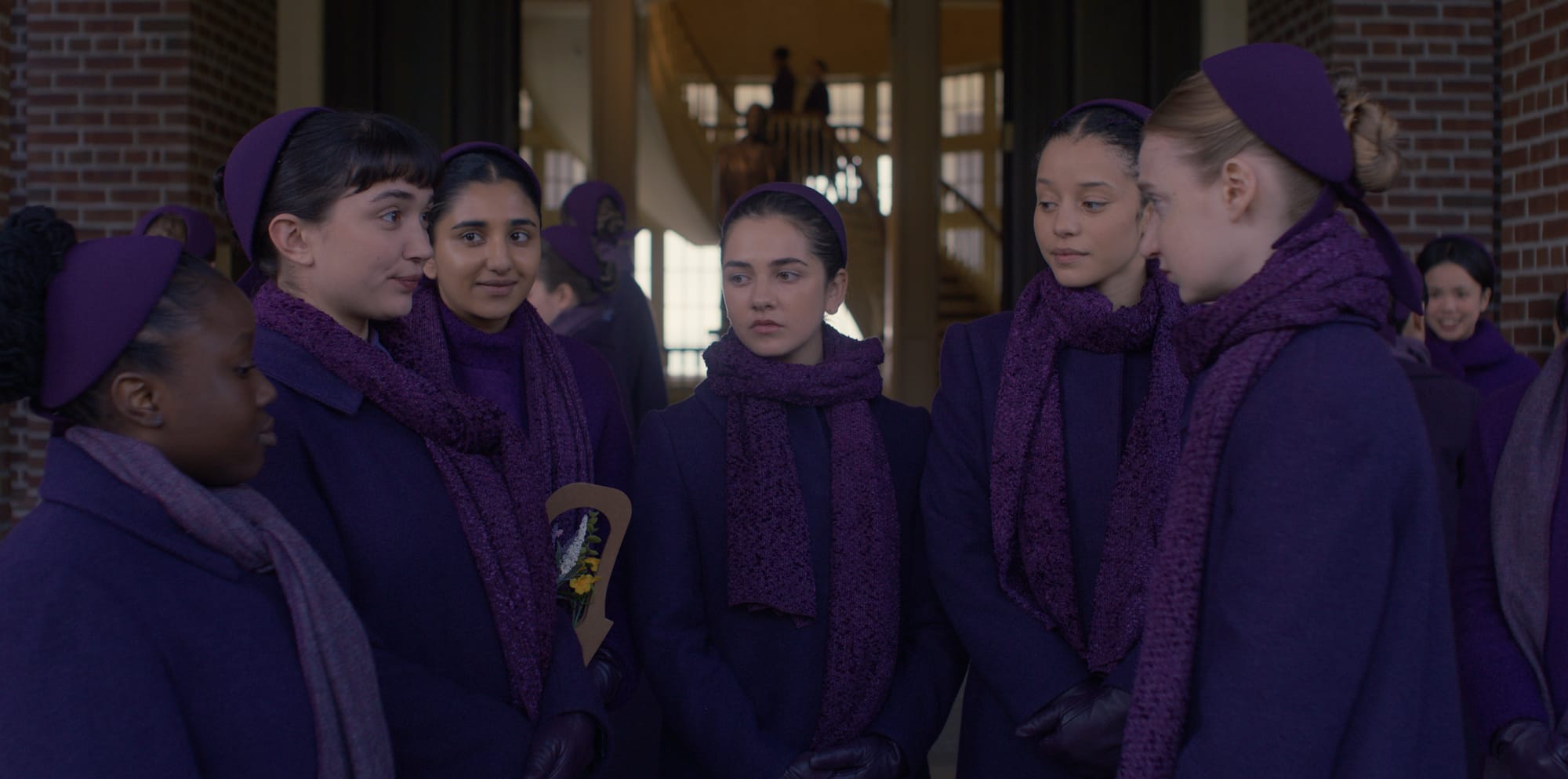

When Hulu first announced that Margaret Atwood's Booker Prize-winning sequel novel would become a television series, there was reason for both excitement and trepidation. The Handmaid's Tale ran for six seasons, stretching well beyond the boundaries of Atwood's original 1985 novel and, at times, beyond the patience of even its most devoted viewers. Could a sequel series — one that needed to reconcile a novel written as a follow-up to a 35-year-old book with a TV show that had spent five seasons inventing its own continuity — actually work?
The answer, against considerable odds, is yes. The Testaments is excellent television. It is also, importantly, a very different show than The Handmaid's Tale, and viewers who go in expecting the same relentless, airless oppression of the original may find themselves disoriented by the shift. That disorientation, however, is very much the point.
A Different Gilead, Seen Through Different Eyes
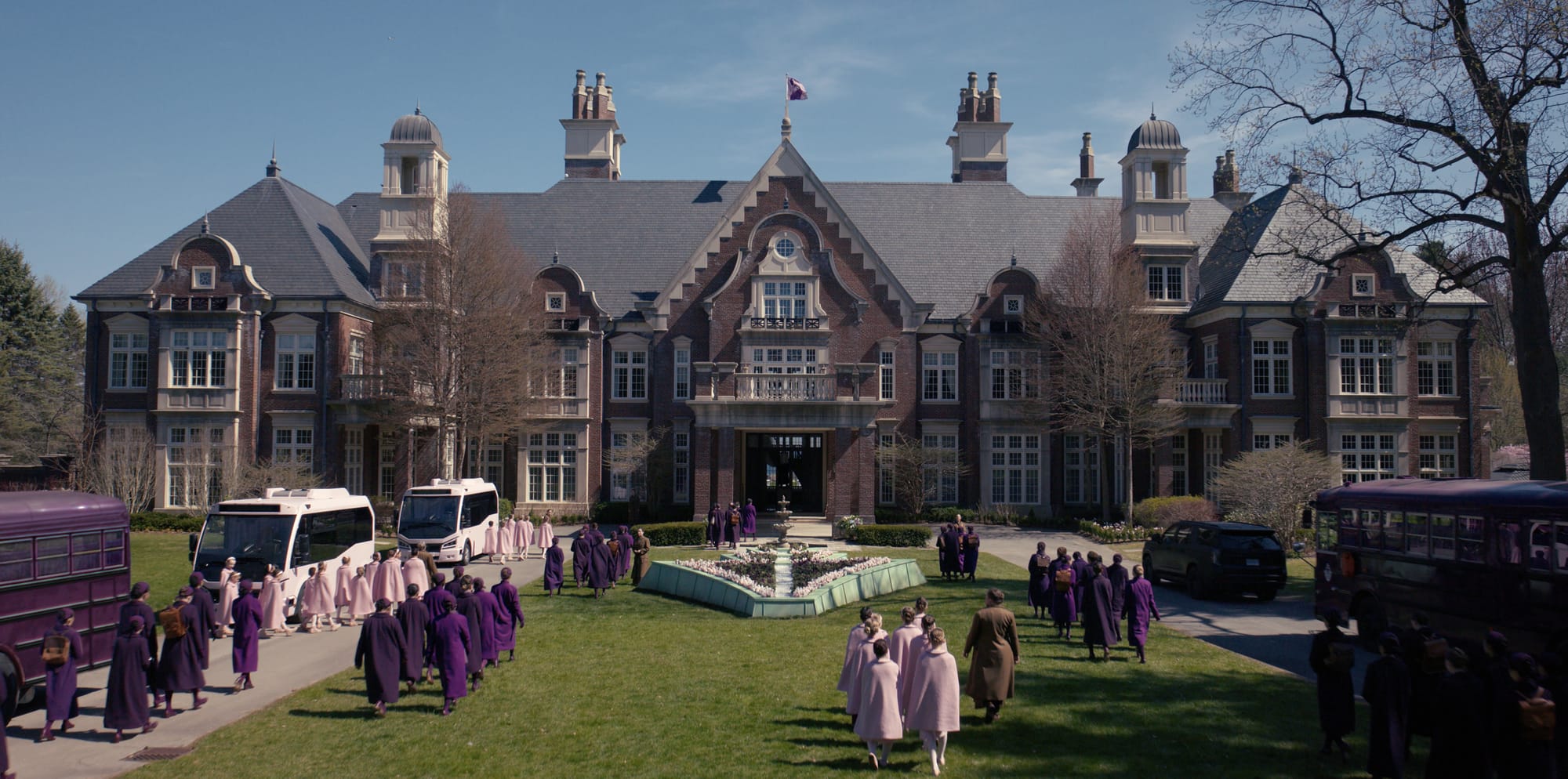
The Handmaid's Tale was, by design, claustrophobic. The camera lingered on Elisabeth Moss's face in extreme close-up as June endured horror after horror, and the show's visual grammar — washed-out light, rigid framing, oppressive silence — became synonymous with prestige misery. It was brilliant and frequently unbearable.
The Testaments opens its aperture. Set roughly four to five years after the finale of The Handmaid's Tale, the series follows two teenage protagonists: Agnes (Chase Infiniti), the daughter June spent six seasons fighting to recover, now a dutiful young woman being groomed for marriage within Gilead's elite; and Daisy (Lucy Halliday), a Canadian teen whose life is upended when she discovers her own connection to the theocratic regime. Both navigate their stories under the watchful eye of Aunt Lydia (Ann Dowd), who now runs an elite preparatory school for future wives and a new social class called the Pearl Girls.
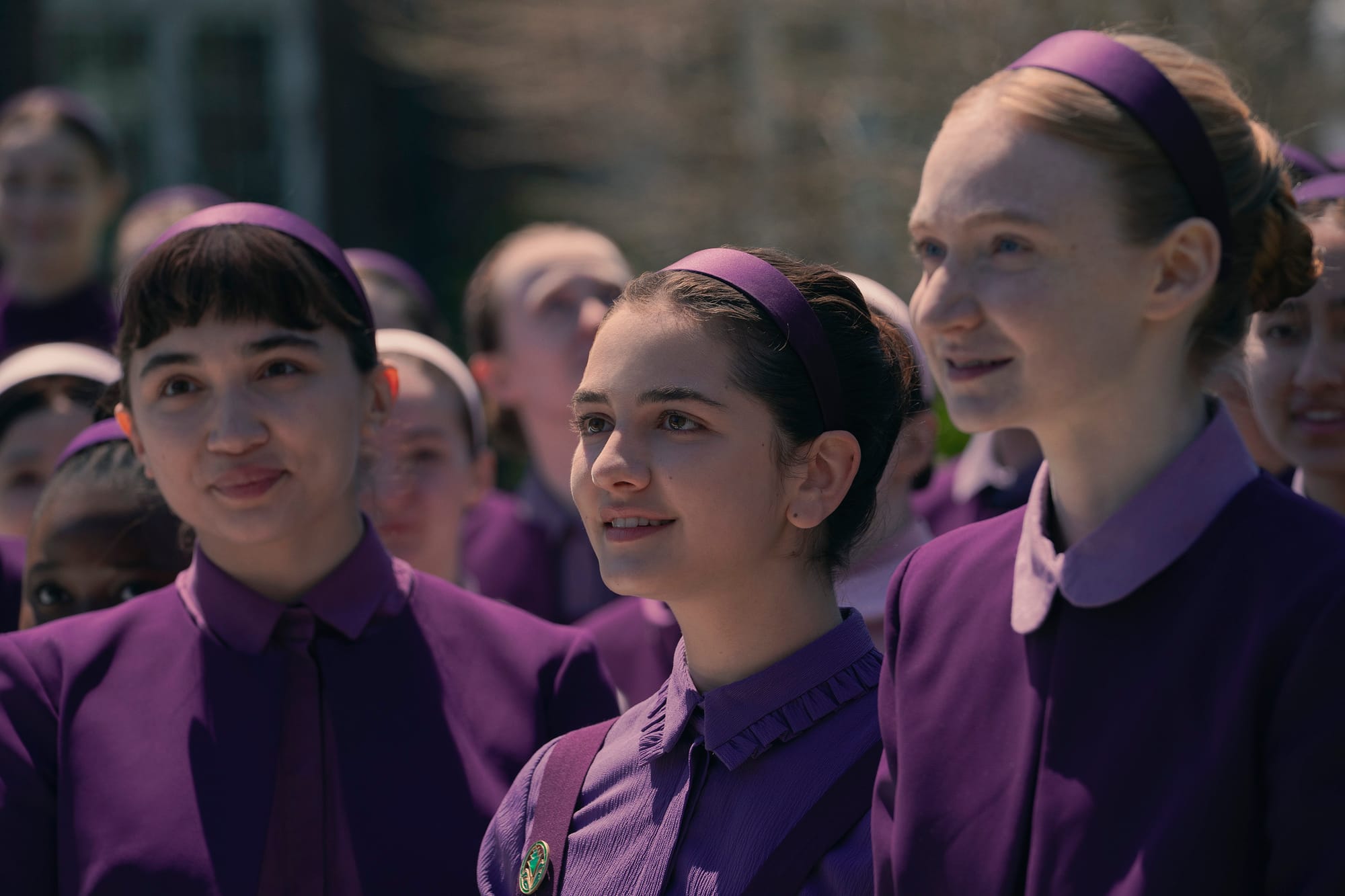
Because its protagonists are young women who have grown up inside Gilead — who have no memory of the world before — the show's early episodes carry a tone that is genuinely surprising. There is lightness here. Teenage friendships, rivalries, whispered secrets, and the particular intensity of adolescent bonds all play out within the gilded halls of Lydia's school. Showrunner Bruce Miller has spoken about showing a "completely opposite side of Gilead," and the series delivers on that promise. For the girls at the center of this story, Gilead isn't an occupation — it's simply the world.
This is what makes the show's darker moments land with such devastating force. The Testaments understands something essential about how authoritarian regimes sustain themselves: not solely through visible violence, but through normalization. The series' lighter, coming-of-age passages make the intrusions of Gilead's true nature — the casual cruelty, the sudden disappearances, the moments where the machinery of oppression becomes impossible to ignore — feel genuinely shocking rather than numbingly expected. Where The Handmaid's Tale kept its boot on your throat for entire episodes, The Testaments lets you breathe just long enough to forget where you are. Then it reminds you. The juxtaposition is, in some ways, more effective than the original's sustained assault.
The Cast Rises to the Occasion
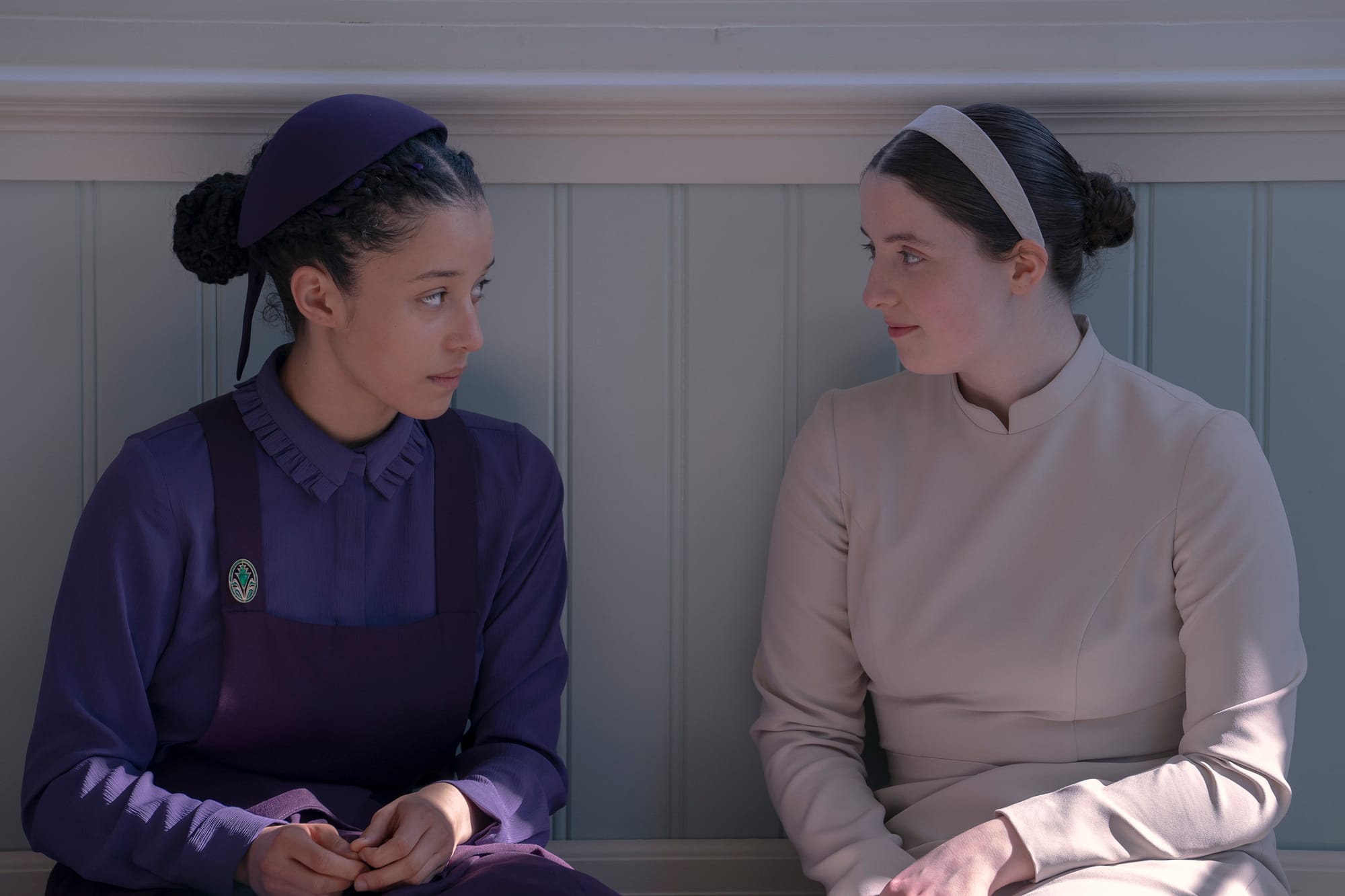
Chase Infiniti, who earned substantial attention and awards recognition for her work in Paul Thomas Anderson's One Battle After Another, proves that her talent translates seamlessly to the serialized format. Her Agnes is a study in carefully controlled surfaces — pious, obedient, watchful — and Infiniti makes the character's slow awakening feel organic rather than predetermined. You can see Agnes thinking behind her eyes in a way that recalls the best work Moss did in early seasons of the original.
Lucy Halliday brings a necessary counterweight as Daisy, whose outsider perspective provides the audience's entry point into the world. Where Agnes moves through Gilead with practiced grace, Daisy stumbles and bristles, and Halliday makes her defiance feel earned rather than performed. The show wisely avoids making Daisy a simple audience surrogate; she has her own blind spots and naïveté that complicate her heroism.
The supporting ensemble is uniformly strong. Rowan Blanchard brings sharp, dangerous energy as Shunammite, the pampered daughter of a prominent Gilead family. Mattea Conforti's Becka provides quiet emotional depth. Mabel Li and Amy Seimetz flesh out the world in supporting roles that feel lived-in rather than functional.
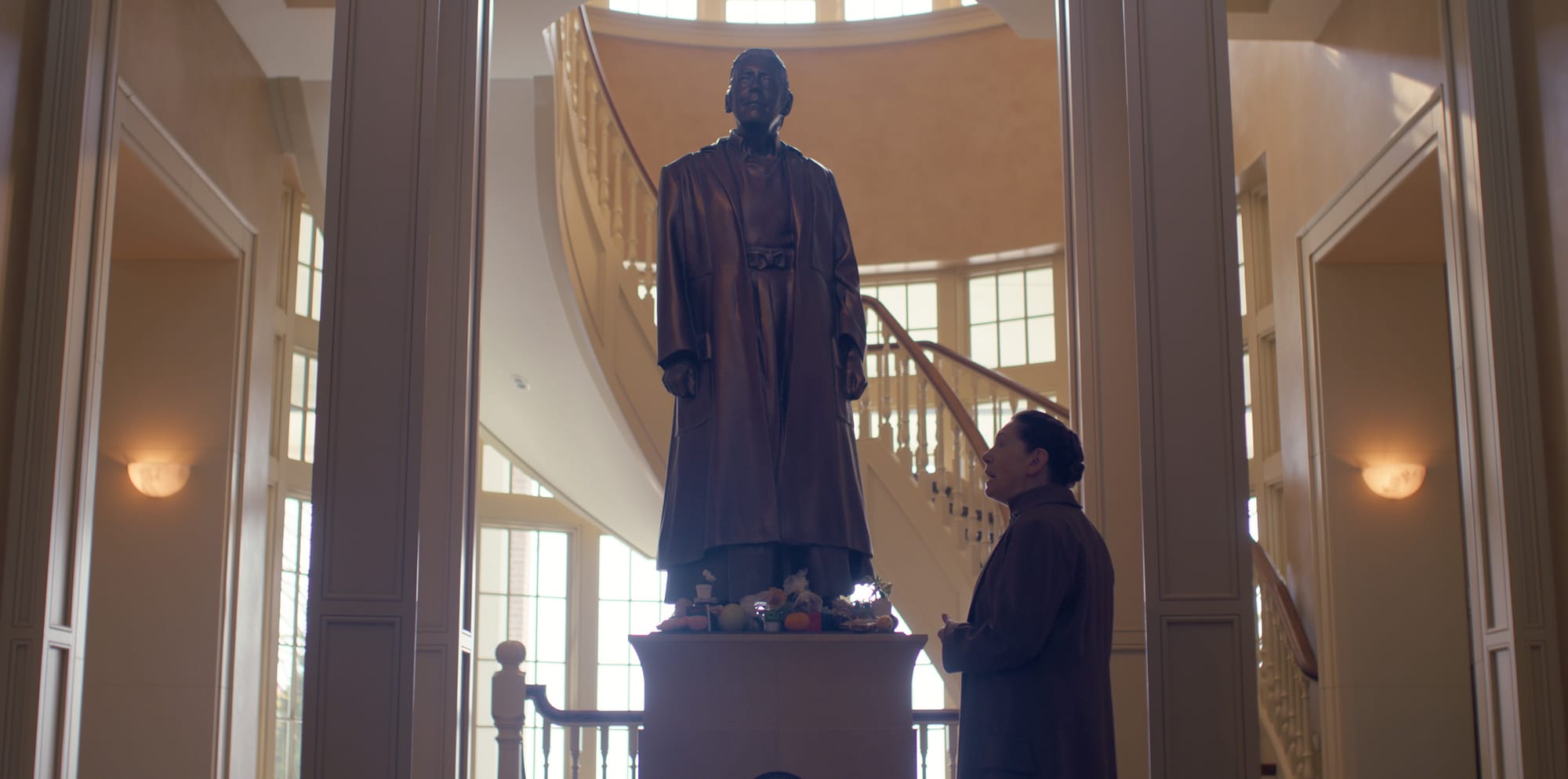
But the show belongs, as it always has, to Ann Dowd.
Dowd's Aunt Lydia was the most compelling figure in The Handmaid's Tale — a villain who believed utterly in her own righteousness, who could deliver devastating cruelty and genuine tenderness in the same scene. In The Testaments, the character undergoes a transformation that Dowd has described as becoming more "protective" than rebellious. This Lydia has experienced her moral reckoning. She still believes in Gilead — or at least in her version of it, in the Pearl Girls who come to her school voluntarily and whom she guards with fierce devotion. But something has shifted behind her eyes, and Dowd plays the duality with a precision that borders on surgical. Every scene she occupies is richer for her presence. She was the best thing about the original show. She may be even better here.
The Adaptation Question
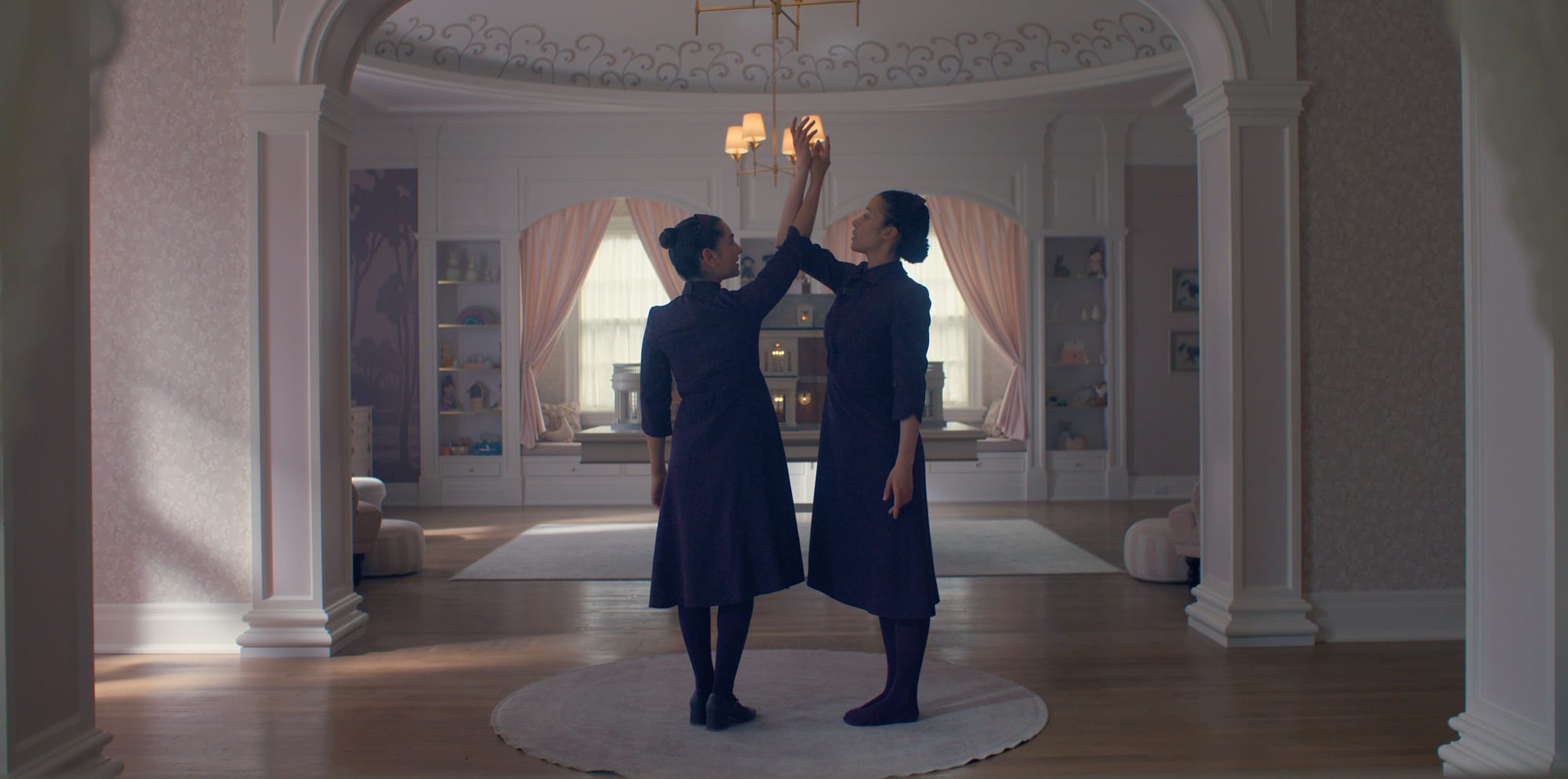
Any adaptation of The Testaments was going to face a unique structural challenge. Atwood wrote her novel as a sequel to her 1985 book, picking up fifteen years after the events of that story. The television series, however, needs to follow six seasons of a show that invented enormous amounts of plot beyond the original novel — including an entirely original arc for June that saw her escape Gilead, wage guerrilla warfare, and ultimately throw herself back across the border to find Hannah.
The show handles this with reasonable elegance. The time jump is compressed to roughly four or five years after the series finale rather than the novel's fifteen-year gap from the original book, which allows the events of the TV series to sit comfortably in recent memory for the characters. Agnes's backstory is adjusted to account for the show's version of Hannah's kidnapping and the drama surrounding Baby Nichole, rather than hewing to the novel's version of events. Certain plot mechanics are shuffled, and some characters' relationships to Gilead's power structure are reconfigured to match the political landscape the TV series established.
Most of these changes are forgivable — some are arguably improvements, streamlining Atwood's occasionally labyrinthine plotting into something more dramatically propulsive. The novel's tripartite structure, alternating between Aunt Lydia's secret manuscript, Agnes's testimony, and Daisy's account, is preserved in spirit if not in rigid form. Readers of the book will recognize the scaffolding even when the furniture has been rearranged. A few alterations may sting for purists, particularly where the show departs from Atwood's characterization of Lydia's pre-Gilead life — but these changes feel motivated by the need to maintain continuity with Dowd's six-season performance rather than by carelessness. They are compromises born of the unusual position this adaptation occupies: adapting a book that is itself a sequel to a different book, while serving as a sequel to a show that diverged wildly from that same source material. That the show manages this balancing act at all is impressive. That it does so while remaining genuinely compelling is something close to remarkable.
The Verdict
The Testaments is not The Handmaid's Tale Season 7, and it shouldn't be. It is a show that understands Gilead deeply enough to know that the most terrifying thing about a totalitarian regime isn't the violence — it's the way people learn to live within it, the way horror becomes invisible through familiarity. By centering young women who have never known anything else, the series finds fresh angles on a world that six seasons of television might have exhausted. By shifting its tone without softening its substance, it earns the right to exist as its own thing.
Ann Dowd continues to do career-defining work. The young cast is revelatory. The adaptation, while imperfect, navigates an almost impossibly complicated continuity puzzle with intelligence and care.
The Testaments premieres April 8, 2026, with three episodes on Hulu. New episodes release weekly.