VisionQuest Review: The WandaVision Trilogy Ends on Its Strangest, Most Soulful Note

Score: 9/10
Five years after WandaVision turned a sitcom pastiche into a meditation on grief, Marvel is finally finishing what it started. VisionQuest, premiering October 14 on Disney+, closes out the unlikely trilogy that ran through Agatha All Along— and it does so by going somewhere neither of its predecessors dared: all the way inside Vision's head. The result is the most ambitious Marvel series since Loki, a show that's equal parts sci-fi puzzle box, family drama, and a long overdue reckoning between a son and the father who tried to destroy the world.
A Vision Who Remembers Everything and Feels Nothing
When we last saw the White Vision, he'd had his memories restored by his grief-built counterpart and flown off into the sky. VisionQuest picks him up rebooted, on the run from the people who wanted to turn him into a weapon, and living in hiding. The hook is deceptively simple: Vision has his memories back, but he doesn't feel them. He knows he loved Wanda. He knows he had sons. None of it feels like it belongs to him.
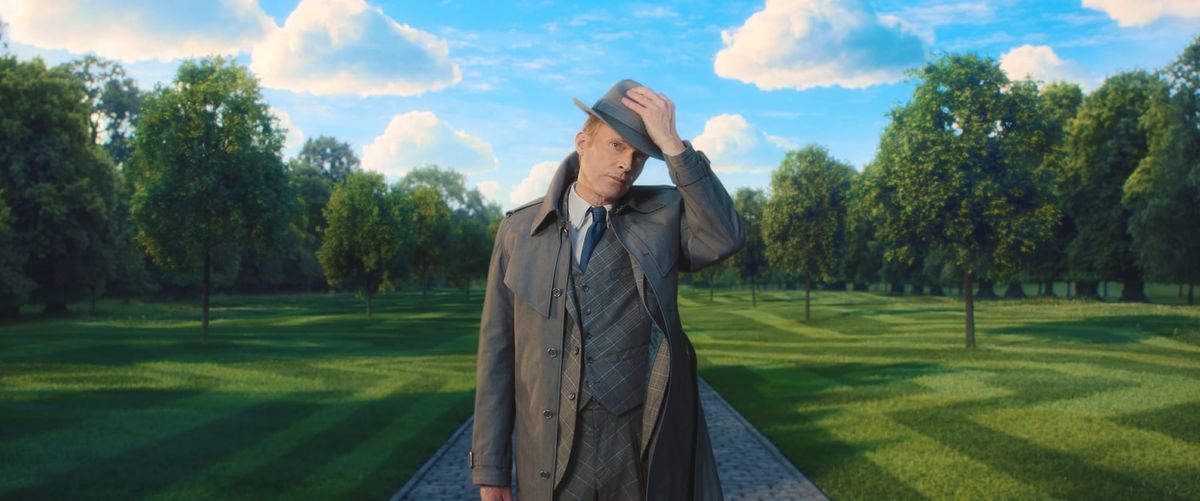
That gap — between remembering a life and owning it — is the engine of the whole season, and Paul Bettany plays it beautifully. After years of being the MCU's most reliable supporting player, he finally gets a show built entirely around him, and he makes the most of every frame. Bettany has always been a master of stillness, and here that stillness carries the weight of an entire life Vision can recall but can't quite claim. It's a performance that's dry, funny, and quietly devastating, often within the same scene.
Ultron Is Back, and He's Never Been Better
If Bettany is the heart, James Spader is the jolt of electricity. Avengers: Age of Ultron never gave Spader's villain much room beyond quips and world-ending speeches. VisionQuest fixes that. Showrunner Terry Matalas has said the Vision-Ultron relationship is the central pillar of the series, and Spader has described it as a "father-son-therapist-psychopath" dynamic — which is exactly how it plays on screen.
Ultron loves Vision and hates him, sometimes in the same sentence, and Spader finds every shade in between. Their scenes together crackle like a family argument that's been simmering for a decade: wounded, petty, affectionate, and dangerous all at once. This is a show about intergenerational trauma that just happens to star two synthetic beings, and it's sharper for it.
A Mind Full of Ghosts
Much of the series unfolds inside a reality-bending mansion within Vision's own mind, where he's been quietly preserving other artificial intelligences to keep them alive. That means a gloriously deep bench of familiar voices given human form: James D'Arcy as J.A.R.V.I.S., Orla Brady as F.R.I.D.A.Y., Emily Hampshire as E.D.I.T.H., and Henry Lewis and Jonathan Sayer as Tony Stark's lovable robot arms, D.U.M.-E and U.
On paper it sounds like fan service. In practice, it's one of the show's smartest choices — a found family of orphaned AIs, each shaped by the same absent father figure, reflecting Vision's own questions back at him. Each of them gets a distinct personality, and the series is at its most playful when they're bouncing off one another, and off Vision.
Matalas Brings the Picard Touch
Marvel tapped Matalas after his run on Star Trek: Picard Season 3 and 12 Monkeys, and his fingerprints are everywhere: a genuine love for legacy characters, a willingness to get weird with time and identity, and a knack for landing emotional beats without undercutting them with a joke. Directed by Matalas alongside Christopher J. Byrne, Gandja Monteiro, and Vincenzo Natali, the series is also visually the most distinctive Marvel show in years. The mind-mansion setting gives it license to bend space, memory, and genre in ways that echo the trilogy's boldest swings without simply repeating them.
Crucially, VisionQuest respects where it came from without leaning on it. Bettany has said the show feels like part of that world and the end of a trilogy, while still being very much its own thing. That's exactly right.
The Supporting Cast
Ruaridh Mollica steps into the role of a grown-up Tommy Maximoff, and his scenes with Bettany give the father-son theme a second, warmer layer. Todd Stashwick is a menacing presence as Paladin, the relentless mercenary hunting Vision — Matalas has compared him to Boba Fett, and the comparison holds. T'Nia Miller's Jocasta, a deep-cut pull from the comics, brings a sharp, unsettling edge as a vengeful synthetic with a score of her own to settle. And while Elizabeth Olsen's Wanda remains offscreen after Multiverse of Madness, her absence hangs over everything in a way that feels earned rather than exploited.
Any Complaints?
If there's a knock against VisionQuest, it's that the middle stretch takes its time building the mansion's mythology before things accelerate. It's a minor complaint, and the payoff more than justifies the patience.
The Verdict
VisionQuest is the rare Marvel series that actually has something to say — about memory, about inheritance, about whether we're defined by what we remember or by what we choose to feel. It's funny, strange, and genuinely moving, and it gives Paul Bettany the showcase he's deserved for more than a decade. As a capper to the WandaVision trilogy, it's a near-perfect landing. As a standalone series, it's simply one of the best things Marvel has put on Disney+.
VisionQuest premieres Wednesday, October 14, on Disney+.